Future of Wrapped Tokens and Interoperability: What’s Next for Cross-Chain Assets
Imagine trying to send a message from an iPhone user to an Android user in the early 2010s. You couldn't just hit "send." You needed a specific app, a specific protocol, or you were stuck with clunky SMS that stripped away images and group chats. That friction is exactly what wrapped tokens solve in the crypto world. They are digital proxies, allowing assets like Bitcoin to function on networks they weren't built for, such as Ethereum. But here is the uncomfortable truth: these proxies are expensive, risky, and increasingly seen as a temporary bandage on a broken system. As we move through 2026, the industry is racing to replace this clunky middleman with native blockchain interoperability.
Why We Need Wrapped Tokens (And Why We Hate Them)
At their core, wrapped tokens exist because blockchains don't talk to each other natively. Bitcoin is great at storing value but terrible at running complex smart contracts. Ethereum does the opposite. To use Bitcoin's liquidity in Ethereum's decentralized finance (DeFi) ecosystem, you need a representation of it there. Enter WBTC, launched back in January 2019. It became the giant of the space, locking up billions in real Bitcoin to issue equivalent ERC-20 tokens on Ethereum.
The problem? Trust. When you hold WBTC, you aren't holding Bitcoin directly; you're holding a claim on Bitcoin held by a custodian. If that custodian gets hacked, goes bankrupt, or decides to freeze your funds, your "Bitcoin" is worthless. This isn't hypothetical. The Ronin Bridge hack in March 2022 drained $625 million, and Wormhole lost $325 million earlier that same year. These events shattered the illusion that bridging is safe. Users in communities like r/defi frequently complain about failed transactions and high fees, with surveys showing nearly a third of users cite bridge failures as their biggest headache.
The Three Ways We Wrap Assets Today
Not all wrapped tokens are created equal. The technology behind them falls into three main buckets, each with its own trade-offs between speed, cost, and security.
- Custodial Wrapping: This is the WBTC model. A centralized entity holds the original asset in a multi-signature wallet. It's simple and fast, but you have to trust the company holding the keys. BitGo, the custodian for WBTC, uses a 6-of-8 signature requirement, which is secure but still centralized.
- Algorithmic Wrapping: Here, smart contracts handle the job. Maker Protocol’s WETH is a prime example. You lock ETH, and the contract mints WETH. It requires overcollateralization-often 150%-to ensure the system stays solvent if prices crash. It’s trustless but capital inefficient.
- Federated Wrapping: This uses a network of validators instead of one company. Ren Protocol tried this with a 21-validator network before shutting down in late 2022 due to complexity and low adoption. It aims for decentralization but often struggles with performance.
The market has spoken. WBTC dominates with over 70% of the wrapped Bitcoin market share. Why? Because despite the centralization risk, it works. Developers know how to integrate it, and liquidity providers feel comfortable using it. But comfort doesn't mean efficiency.
Bridges: The Bottleneck of DeFi
If wrapped tokens are the product, cross-chain bridges are the delivery trucks moving them. Currently, over $7.4 billion sits locked in various bridges across 47 active networks. The mechanics vary wildly, affecting both speed and safety.
| Protocol | Mechanism | Chains Supported | Avg. Transfer Time | Security Model |
|---|---|---|---|---|
| Wormhole | Lock-and-Mint | 23 | ~15 seconds | Guardian Network |
| Synapse | Burn-and-Mint | 18 | Variable | Validator Set |
| Hop Protocol | Liquidity Network | Ethereum L2s | Minutes | Staked Liquidity |
| Stargate | Omnichain Pool | 7 | Fast | LayerZero Messaging |
Notice the disparity in transfer times. Moving ETH from Ethereum to Polygon takes about 7-8 minutes. But withdrawing from Arbitrum? That can take seven days. Why? Fraud proofs. Layer 2 networks need time to prove they haven't cheated. For a trader looking to exit a position during a market crash, seven days is an eternity. This latency forces users to keep more capital idle in bridges than they’d like, creating inefficiency.
The Shift Toward Native Interoperability
So, where is this heading? Industry leaders are betting big that wrapped tokens will eventually become obsolete. Vitalik Buterin, Ethereum’s co-founder, called bridges "fundamental security bottlenecks" back in 2023. He wasn't wrong. The current model relies on external security assumptions-if the bridge breaks, the asset is gone.
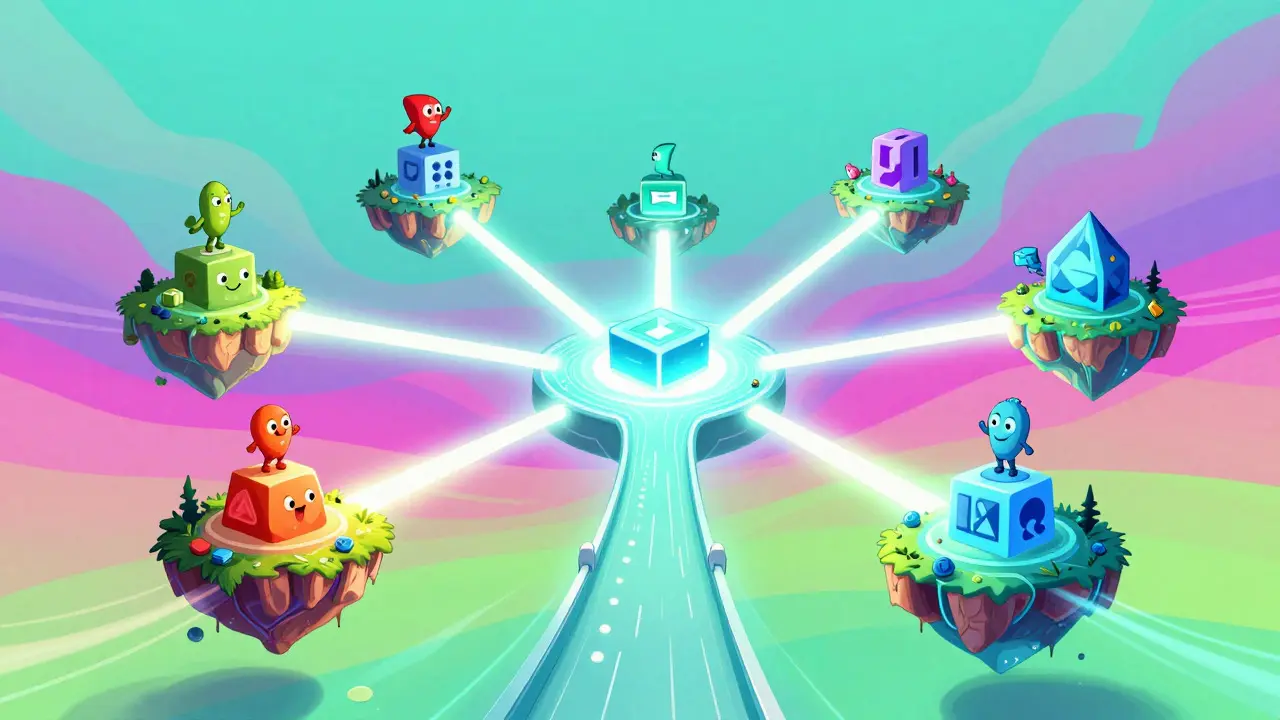
The future lies in protocols that allow chains to communicate directly without a middleman holding custody. Two technologies are leading this charge: Zero-Knowledge (ZK) Proofs and Intent-Based Architectures.
ZK proofs allow one chain to mathematically verify that a transaction happened on another chain without trusting a validator. Projects like zkSync Era and Polygon zkEVM are building this into the infrastructure. Anatoly Yakovenko, founder of Solana, predicted in 2024 that direct interoperability via ZK proofs would dominate by 2027. He argues that wrapped tokens are just a workaround for a lack of native communication.
Then there are intents. Instead of you manually bridging USDC from Ethereum to Base, swapping it for SOL, and sending it to Solana, you simply state your intent: "I want SOL on Solana." An off-chain solver finds the best path, executes the swaps and bridges, and settles it on-chain. UniswapX and 1inch Fusion are already processing billions in volume using this method. It abstracts away the complexity entirely. You don't care about bridges; you just get your asset where you want it.
Regulatory Headwinds and Institutional Adoption
Technology aside, regulation is shaping the future of wrapped tokens. In the EU, the Markets in Crypto-Assets (MiCA) regulation, effective since January 2024, demands strict 1:1 backing and monthly attestations for issuers. This favors large, compliant players like BitGo (WBTC) but hurts smaller, algorithmic wrappers that can't afford the compliance overhead.
In the US, things are murkier. Treasury proposals suggest classifying some wrapped tokens as securities if they are too centralized. This could force a redesign of many existing products. Yet, institutions are diving in anyway. JPMorgan’s Onyx platform uses wrapped tokens for daily settlements worth hundreds of billions. They need the liquidity, even if they dislike the risks. This institutional demand keeps wrapped tokens alive, but it also pressures developers to build safer, more transparent systems.
What This Means for You
If you're a developer, stop building custom bridges. Use established standards like Chainlink CCIP or Axelar. Documentation quality matters-Cosmos IBC rates highly among devs for clarity, while proprietary bridges often leave you guessing. Expect integration times of 40-120 hours for complex setups.
If you're a user, diversify your risk. Don't keep all your wrapped assets in one bridge. Keep an eye on audits. And watch for the rise of intent-based exchanges. They promise lower fees and faster settlement by hiding the plumbing. By 2026, the goal isn't to wrap everything; it's to make wrapping unnecessary.
Are wrapped tokens safe?
They carry significant risk. While major ones like WBTC are audited regularly, the underlying bridge or custodian can fail. Historical hacks like Ronin ($625M) and Wormhole ($325M) show that smart contract bugs and key management errors are real threats. Always check recent audit reports before holding large amounts.
Will wrapped tokens disappear completely?
Probably not entirely, but their role will shrink. Native interoperability protocols like Cosmos IBC and emerging ZK-based solutions reduce the need for proxies. However, for legacy assets like Bitcoin wanting access to new ecosystems, wrapping will likely persist for years, albeit with better security models.
Which bridge is fastest?
It depends on the chains involved. Solana-based Wormhole transfers can complete in ~15 seconds. Ethereum to Polygon takes about 7-8 minutes. Withdrawals from Ethereum Layer 2s like Arbitrum can take up to 7 days due to fraud proof windows. Speed often trades off with security guarantees.
What are intent-based bridges?
Intent-based systems let you specify what you want (e.g., "Swap ETH on Ethereum for USDC on Optimism") rather than how to do it. Off-chain solvers compete to fulfill your request most efficiently, handling the bridging and swapping logic behind the scenes. This reduces user error and often lowers costs.
How do regulations affect wrapped tokens?
Regulations like MiCA in Europe require strict proof of reserves and transparency. In the US, potential securities classifications for centralized wrappers could limit their utility or force legal restructuring. Compliance costs are rising, favoring larger, well-capitalized issuers over small experimental projects.
Laine Van Sickle
August 29, 2026 AT 18:08ugh this is so long and i barely understood half of it but yeah bridges suck
also why do we still trust companies with our money?? its 2026 come on
Paul Needham
August 30, 2026 AT 20:33Oh wow, another article explaining to me that my money can disappear if a bridge gets hacked. Groundbreaking stuff. Truly revolutionary insights here. I'm sure everyone who lost their life savings in Ronin is just thrilled to read about "native interoperability" now.
It's cute how you pretend ZK proofs are some magic wand that fixes everything instantly while ignoring the massive computational overhead and latency issues that make them useless for high-frequency trading right now.
Jillian Pye
August 31, 2026 AT 23:21I find the philosophical implications of wrapped tokens fascinating. 🤔 It really speaks to the human desire for connection across disparate systems, doesn't it? We build these proxies because we cannot bear the isolation of separate ledgers. Yet, in doing so, we introduce fragility into what should be robust structures. It’s a metaphor for modern relationships, perhaps. 🌿
We seek unity through intermediaries, yet those very intermediaries become points of failure. It makes one wonder if true interoperability requires a fundamental shift in how we perceive ownership itself, rather than just technical solutions.
Jane yuan
September 2, 2026 AT 20:52This whole concept of wrapping assets is a sign of American corporate greed trying to control decentralized tech. The EU regulations under MiCA show actual leadership compared to the chaotic US approach. We need strict oversight, not more complex crypto jargon designed to confuse the average person.
Why should we rely on private custodians when national banks could handle this better? The focus on "decentralization" often masks the centralization of power in the hands of a few tech elites. True sovereignty means understanding where your money actually sits, not trusting a smart contract you didn't write.
nic c
September 3, 2026 AT 08:35Let me educate you all on why this analysis is superficially correct but fundamentally misses the deeper structural inefficiencies at play here. You talk about ZK proofs as if they are a silver bullet, completely ignoring the fact that proving systems themselves require trusted setups and significant computational resources that are currently bottlenecked by hardware limitations.
The real issue isn't just the bridging mechanism; it's the lack of a unified state machine across chains. Until we have something akin to a global consensus layer, wrapped tokens will remain necessary evils because the economic security models of individual chains are too fragmented to support native cross-chain execution without massive slashing risks.
Furthermore, the regulatory landscape mentioned regarding MiCA is vastly oversimplified. Compliance costs don't just hurt small players; they create moats that entrench incumbents like BitGo, effectively killing innovation in the wrapping space before it even begins. This isn't progress; it's consolidation disguised as technological evolution.
And let's not forget the UX nightmare of intent-based solvers. Who audits the solvers? What happens when an off-chain solver goes offline during peak volatility? The abstraction layers being built today are merely shifting risk from on-chain contracts to off-chain infrastructure, which is arguably less transparent and harder to regulate.
The author assumes a linear progression toward native interoperability, but history shows us that technology adoption is rarely linear. Legacy systems persist because they work well enough, and WBTC works well enough for institutional capital despite its risks. Dismissing it as a "temporary bandage" ignores the inertia of billions of dollars in liquidity that refuses to move until the alternative is demonstrably superior in every metric, not just theoretical security.
Kevin Payette
September 3, 2026 AT 18:19You're all missing the point. It's not about tech. It's about leverage.
Wrapped tokens allow infinite recursion of debt. That's the game.
ZK is just new tech for old scams.
Wake up.
Rebecca Springer
September 3, 2026 AT 20:13I think it’s important to remember that different regions adopt technology based on local needs. In many parts of Asia and Africa, mobile-first solutions drive adoption, whereas Western markets focus on DeFi complexity.
Perhaps the future isn't just about faster bridges, but about designing interfaces that respect diverse cultural approaches to finance. Not everyone wants to manage keys or understand fraud proofs; some just want to send value home reliably. 😊
David Powell
September 4, 2026 AT 19:41How quaint. Another piece of content marketing dressed up as analysis. The distinction between custodial and algorithmic wrapping is elementary knowledge for anyone who has been in this space longer than six months.
The mention of "intent-based architectures" is particularly amusing given that most users still cannot execute a simple swap without losing their minds over gas fees. Until the user experience matches the sophistication of the backend, these protocols are just toys for developers.
Ellie Brooks
September 5, 2026 AT 05:07I am SO excited about the potential here! Imagine a world where you don't have to worry about which chain your asset is on! It feels like we are finally breaking down these silos!
But seriously, does anyone else feel overwhelmed by the choices? Like, I want to use UniswapX but I also hear good things about 1inch Fusion... how do I know which one is best for my specific transaction size?
Also, the idea of "intents" sounds magical but I worry about the learning curve. My mom uses crypto to buy coffee sometimes (yes, really!) and she definitely won't care about "off-chain solvers." She just wants her coffee. How do we make this accessible for people who aren't tech-savvy?
And what about the environmental impact? ZK proofs are energy efficient compared to PoW, but running constant solver networks adds up. Are we thinking about sustainability in these new designs? I hope so because I care deeply about green tech!
Dave Worth
September 6, 2026 AT 12:52They’re hiding the truth. 🕵️♂️
Why do you think bridges get hacked so much? Because the validators are compromised. 🚫👀
Who controls the validator sets? Big VC firms. 💸
They want you to think ZK is the answer, but ZK requires trusted setups initially. TRUSTED SETUPS mean backdoors. 🔓
Follow the money. Always follow the money. 💰🧐
Kelechi Precious Nwachukwu
September 6, 2026 AT 18:47My brother, this thing dey sweet but e hard o! 🙏
Na waala help us understand this ZK thing because my head no gree rest. If Bitcoin na king, why we dey wrap am like gift box? E dey confuse mind.
But I agree say bridge na wahala. Last time I try send money from Nigeria via bridge, e take two days! Two days! While I dey wait, price drop 20%. Na joke be dat.
We need something simple. Something we fit trust with our eyes closed. No fancy words, just safe transfer. God bless.
Valentine Okpala
September 8, 2026 AT 05:50Interesting perspective. 🤔 It’s funny how we treat blockchain like a solved problem when we’re barely scratching the surface of social coordination.
Maybe the friction isn’t a bug, but a feature? Forces us to slow down and think about what we’re actually moving. 🛑
Anyway, nice summary. 👍
Sean Dalton
September 8, 2026 AT 17:09Absolutely tragic commentary. The sheer arrogance of assuming that American-centric DeFi models apply globally is staggering. We in Europe have had proper financial regulation for decades, unlike the Wild West chaos you seem to celebrate.
And please, spare me the drama about "hacks." Every system has vulnerabilities. The difference is whether you have recourse. In traditional finance, yes. In your precious DeFi, no. You lose your money, you cry yourself to sleep. That’s not innovation; that’s negligence.
These "interoperability" promises are just another bubble waiting to burst. Mark my words.
Bill Patterson
September 9, 2026 AT 18:19WBTC still king. Don't believe the hype. Bridges are risky. Simple as that.
Keep it basic.
Don't touch the new stuff until it's proven.
Rachel Etheridge
September 11, 2026 AT 02:47OH MY GOD THE FRAUD PROOFS!! 😱 Seven DAYS?! I would literally die waiting for my money to come out of Arbitrum during a crash!!! That is absolutely unacceptable!!!
And the custodial risk?? Scary scary scary!!! I keep having nightmares about BitGo freezing my funds!!!
We need better!!! Much better!!! This article made me anxious!!! 😭😭😭
Matt Reckdenwald
September 12, 2026 AT 01:17I hear your anxiety, Rachel, and it’s valid. Waiting seven days feels like an eternity when markets are volatile. It creates such emotional stress, doesn't it? Like holding your breath underwater.
Maybe the solution isn't just faster tech, but better insurance products that compensate for that latency. Or perhaps community-driven liquidity pools that act as buffers. We need to design for human patience, not just machine speed. It’s a beautiful challenge to solve together.
Emmanuel Ogbomo
September 13, 2026 AT 19:42Agreed with Matt. The human element is often overlooked in these technical discussions. Interoperability is ultimately about trust and convenience. If the process causes stress, it fails regardless of cryptographic security. We must balance efficiency with peace of mind.
Melanie Armijo
September 15, 2026 AT 02:49It’s interesting how we frame these problems as purely technical. Maybe the real issue is philosophical: we want decentralization but demand centralized reliability. Wrapped tokens are a paradox of wanting to escape the bank while needing the bank’s safety net. We might never fully resolve this tension, only manage it differently over time.