Kava Swap Review 2026: Is This DEX Worth Your Time?
You want to swap tokens without handing over your private keys. You want speed, low costs, and zero identity checks. That sounds like a dream, right? But when you look at Kava Swap is a decentralized cryptocurrency exchange (DEX) built on the Kava blockchain that allows users to trade assets without intermediaries. It launched in 2019 as part of the broader Kava ecosystem, aiming to bridge the gap between Ethereum’s flexibility and Cosmos’s interoperability. The reality check might surprise you. While the technology is solid, the actual trading experience has some serious limits you need to know before you connect your wallet.
This isn’t Uniswap or PancakeSwap. Kava Swap serves a very specific niche. If you are deep into the Kava ecosystem, it’s useful. If you are looking for a general-purpose place to trade random altcoins, you will likely bounce off quickly. Let’s break down exactly what works, what doesn’t, and whether this platform fits your strategy in 2026.
How Kava Swap Actually Works
To understand Kava Swap, you have to understand the ground it stands on. It runs on the Kava blockchain, which is a Layer-1 network that combines the Ethereum Virtual Machine (EVM) with the Cosmos SDK, allowing for both smart contracts and cross-chain communication. This dual-engine setup is its biggest technical flex. It means you can use standard Ethereum wallets like MetaMask while still tapping into the Inter-Blockchain Communication (IBC) protocol used by Cosmos chains.
The exchange uses an Automated Market Maker (AMM) model. Instead of an order book where buyers and sellers match up, you trade against a pool of liquidity provided by other users. The formula follows the classic constant product curve ($x \times y = k$). This is different from newer models like Uniswap v3’s concentrated liquidity. Kava Spread keeps things simple: liquidity is spread across the entire price range. For beginners, this is less confusing. For pros, it might feel inefficient.
Here is the workflow:
- You connect a Web3 wallet (MetaMask, Ledger, or the native Kava Wallet).
- You select the token pair (e.g., KAVA/USDX).
- You set your slippage tolerance.
- You confirm the swap. Transactions settle in about 3-5 seconds.
No KYC. No account creation. No customer service chat bot asking for your ID. Just pure, non-custodial trading. You keep control of your funds at all times. If you lose your seed phrase, however, there is no recovery option. That is the price of freedom.
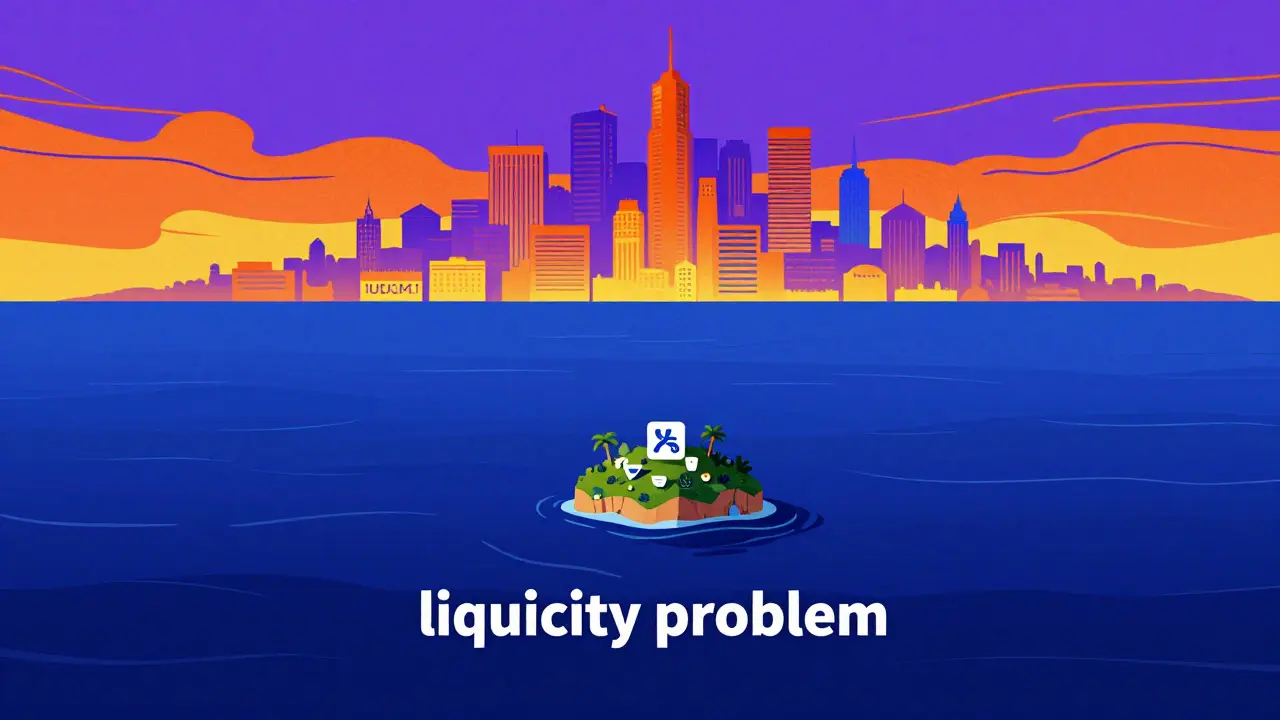
The Liquidity Problem: The Elephant in the Room
Let’s talk numbers because they tell the real story. As of late 2023 data that still reflects the current trajectory, Kava Swap reported a 24-hour trading volume of roughly $14,675. Compare that to Uniswap, which regularly processes over $1 billion daily. That is not a typo. Kava Swap handles a tiny fraction of the market.
Why does volume matter? Because volume equals liquidity. Low liquidity means high slippage. Slippage is the difference between the price you expect and the price you actually get. On Kava Swap, small trades (under $100) often see slippage under 1%. But try to move $500 or more, and you might see slippage jump to 3%, 5%, or even higher. In one user report, a $500 swap resulted in 7.3% slippage and failed transactions.
| Metric | Kava Swap | Uniswap | PancakeSwap |
|---|---|---|---|
| Daily Volume (Approx.) | $14,675 | $1.24 Billion+ | $842 Million+ |
| Listed Assets | 9 | 1,200+ | 1,000+ |
| Average Slippage ($1k trade) | 3.7% | <0.1% | <0.2% |
| Transaction Speed | 3-5 seconds | Varies (Gas dependent) | ~3 seconds |
This data shows why Kava Swap is a niche player. It is not designed for high-volume traders or those wanting to diversify into obscure altcoins. It is built for people who already hold Kava ecosystem assets and need to move them around efficiently within that closed loop.
Fees, Costs, and Hidden Traps
One of the selling points of Kava Swap is the fee structure. According to CoinGecko data, the exchange reportedly charges no explicit trading fees for swaps. However, "no fee" doesn’t mean "free." Here is where you pay:
- Slippage: As mentioned, low liquidity forces you to accept worse prices. This is an implicit cost.
- Gas Fees: While Kava boasts near-zero gas fees compared to Ethereum mainnet, you still pay a tiny amount in KAVA tokens to process transactions. These are negligible but exist.
- Impermanent Loss: If you provide liquidity to earn rewards, you risk impermanent loss. This happens when the price of your deposited tokens changes compared to when you deposited them. Given the low volume, LPs on Kava Swap face significant risks here.
Liquidity providers do earn fees from swap transactions, but with such low volume, the annual percentage yield (APY) is unlikely to compete with major DEXs. You are essentially betting on the growth of the Kava ecosystem rather than earning steady trading revenue.
Security and Trust: Who Watches the Watchers?
In DeFi, security is paramount. Kava Swap’s smart contracts were audited by CertiK, which is a leading blockchain security firm that provides auditing services for smart contracts and DeFi protocols. The audit took place in Q4 2022, with results published in January 2023. They found and resolved three medium-severity vulnerabilities related to price oracle manipulation. This is a good sign-it shows proactive security management.
However, audits are snapshots in time. New code, new integrations, and new exploits emerge constantly. The platform is non-custodial, meaning if you make a mistake-like sending tokens to the wrong address or approving a malicious contract-there is no central authority to reverse the transaction. You are on your own.
The Kava blockchain itself uses a Proof-of-Stake consensus mechanism secured by validators. This adds a layer of security at the network level. But remember, the bridge between chains (IBC) introduces complexity. While IBC is considered secure, any vulnerability in the cross-chain messaging protocol could theoretically impact assets moved through Kava Swap.
User Experience: Simple but Limited
If you are a tech novice, Kava Swap is surprisingly easy to use. The learning curve is rated 'easy' by usability studies. You can connect a wallet in under a minute. The interface is clean, uncluttered, and focuses solely on swapping. There are no charts, no order books, no leverage settings. Just "Swap Token A for Token B."
But simplicity comes at a cost. You cannot set limit orders. You cannot set stop-losses. You cannot trade margin. If you want advanced trading features, Kava Swap will frustrate you. It is a spot exchange only. For most retail users, this is fine. For active traders, it is a dealbreaker.
Support is another weak point. There is no live chat. Email support has an average response time of 38 hours according to user reports. You rely on community Discord channels and documentation. The official docs are comprehensive (27 pages), but if you hit a unique error, you might be stuck waiting for a forum reply.
Who Should Use Kava Swap? (And Who Should Avoid It)
Not every tool is for every job. Here is how to decide if Kava Swap belongs in your toolkit.
Use Kava Swap if:
- You already hold KAVA, USDX, or BTC.b (Kava’s Bitcoin representation).
- You want to avoid bridges and trade directly within the Cosmos ecosystem via IBC.
- You are making small trades (under $100) where slippage is minimal.
- You value privacy and want to avoid KYC requirements.
- You are testing the waters of DeFi and want a low-risk, simple interface.
Avoid Kava Swap if:
- You want to trade popular altcoins like SOL, AVAX, or DOT (they aren’t listed).
- You plan to move large sums of money (liquidity will eat your profits).
- You need advanced order types like limit orders.
- You want high APY from providing liquidity (volumes are too low).
- You prefer centralized exchanges with customer support and insurance.
The Future of Kava Swap in 2026
Is Kava Swap dead? Not necessarily. But it is stagnant. The Kava Labs roadmap through 2024 focused on cross-chain infrastructure and institutional DeFi products, not on boosting the Swap interface. Total Value Locked (TVL) in the Kava ecosystem dropped significantly from its peak, falling from $1.2 billion in early 2022 to under $100 million by late 2023. This decline affects liquidity across all platforms, including Swap.
Analysts suggest Kava Swap will remain a utility component rather than evolving into a standalone competitive DEX. Its fate is tied to the success of the broader Kava blockchain. If Kava attracts institutional players and boosts TVL, Swap might see renewed interest. Until then, it remains a quiet corner of the DeFi world.
For now, treat Kava Swap as a specialized tool. Use it when you are inside the Kava garden. Step outside, and you’ll find bigger, busier markets waiting.
Is Kava Swap safe to use?
Yes, relatively speaking. The smart contracts have been audited by CertiK, and the platform is non-custodial, meaning you control your keys. However, safety also depends on liquidity depth. Low liquidity can lead to poor execution prices, and as with any DeFi platform, you must manage your own wallet security. Never share your seed phrase.
Does Kava Swap require KYC?
No. Kava Swap is a decentralized exchange (DEX) and does not require Know Your Customer (KYC) verification. You simply connect your Web3 wallet (like MetaMask or Ledger) and start trading immediately.
What tokens can I trade on Kava Swap?
The selection is very limited, currently featuring only 9 cryptocurrencies. These primarily include assets native to the Kava ecosystem such as KAVA, USDX (the native stablecoin), and BTC.b (Bitcoin bridged to Kava). You will not find major altcoins like Solana or Cardano here.
Why is my transaction failing on Kava Swap?
Failed transactions are common due to low liquidity and network congestion. The most effective fix is to increase your slippage tolerance setting to 3-5%. Also, ensure you have enough KAVA tokens in your wallet to cover the minimal gas fees required for the transaction.
How does Kava Swap compare to Uniswap?
Uniswap is a global leader with massive liquidity, thousands of tokens, and high trading volume. Kava Swap is a niche DEX with very low volume and limited assets. Use Uniswap for general trading; use Kava Swap only if you specifically need to trade within the Kava/Cosmos ecosystem without using external bridges.
Are there trading fees on Kava Swap?
Kava Swap does not charge explicit trading fees for users. However, you will incur costs through slippage (price impact due to low liquidity) and minimal gas fees paid in KAVA tokens to process the transaction on the blockchain.