Trump Crypto Policy Reversal: 2025 Regulatory Changes Explained
The landscape of American cryptocurrency regulation changed overnight in early 2025. If you have been watching the market since the January inauguration, you likely noticed a sharp pivot from enforcement-heavy tactics to proactive support for digital assets. This isn't just a shift in tone; it is a structural overhaul involving executive orders, new legislation, and the creation of government-held crypto reserves. For investors, developers, and institutions, understanding these Trump crypto policy reversals is no longer optional-it is essential for navigating the next phase of the industry.
The Core Pillars of the 2025 Regulatory Shift
To understand where we are now, we need to look at the three main pillars that defined this transition. The administration moved quickly to replace the previous era’s skepticism with a framework designed to position the United States as the global leader in digital finance. These pillars are not abstract concepts; they are legal instruments that dictate how businesses operate and how assets are treated by the federal government.
- The January 23 Executive Order: Titled "Strengthening American Leadership in Digital Financial Technology," this order created the President's Working Group on Digital Asset Markets. It set a strict 180-day deadline to produce a comprehensive report on regulatory clarity.
- The March 6 Executive Order: This directive established the Strategic Bitcoin Reserve and the U.S. Digital Asset Stockpile, fundamentally changing how the government treats seized cryptocurrencies.
- The GENIUS Act: Signed into law in July 2025, this legislation provides specific statutory rules for stablecoins, market structure, and tax treatment, filling gaps that executive orders could not address.
These actions represent a clean break from the Biden administration’s approach, which relied heavily on agency enforcement actions rather than clear legislative frameworks. The speed of implementation was notable, with the Working Group delivering its 160+ page report exactly on schedule in late July 2025.
The Strategic Bitcoin Reserve: A New Government Asset Class
Perhaps the most controversial and impactful change is the creation of the Strategic Bitcoin Reserve. Under the March 6 Executive Order, the U.S. Treasury Department is now mandated to hold Bitcoin (BTC) obtained through criminal or civil forfeiture proceedings. Unlike traditional seized assets, which are typically auctioned off, this Bitcoin is locked away as a reserve asset.
Here is what you need to know about the mechanics:
- Source of Assets: The reserve is capitalized exclusively with BTC forfeited from illegal activities. No taxpayer money is used to purchase new coins.
- No Sales Clause: The White House explicitly stated that this Bitcoin will never be sold. It is treated similarly to gold reserves-held for strategic stability rather than liquidity.
- Current Holdings: As of March 31, 2025, the reserve held approximately 214,000 BTC, valued at around $14.2 billion at the time.
Alongside this, the U.S. Digital Asset Stockpile was created for non-Bitcoin assets. The key difference here is flexibility: the Treasury Secretary retains the authority to determine strategies for stewardship, including potential sales, though no new purchases are authorized for this stockpile. This distinction highlights the administration’s specific faith in Bitcoin as a store of value while maintaining operational flexibility for other altcoins.
| Feature | Strategic Bitcoin Reserve | Digital Asset Stockpile |
|---|---|---|
| Asset Type | Bitcoin (BTC) only | Non-Bitcoin digital assets (ETH, etc.) |
| Acquisition Method | Criminal/Civil Forfeiture | Criminal/Civil Forfeiture |
| Sale Authority | Prohibited (Never Sold) | Allowed (Treasury Discretion) |
| New Purchases | None | None |
| Primary Goal | Strategic Reserve/Hedge | Stewardship/Liquidity Management |
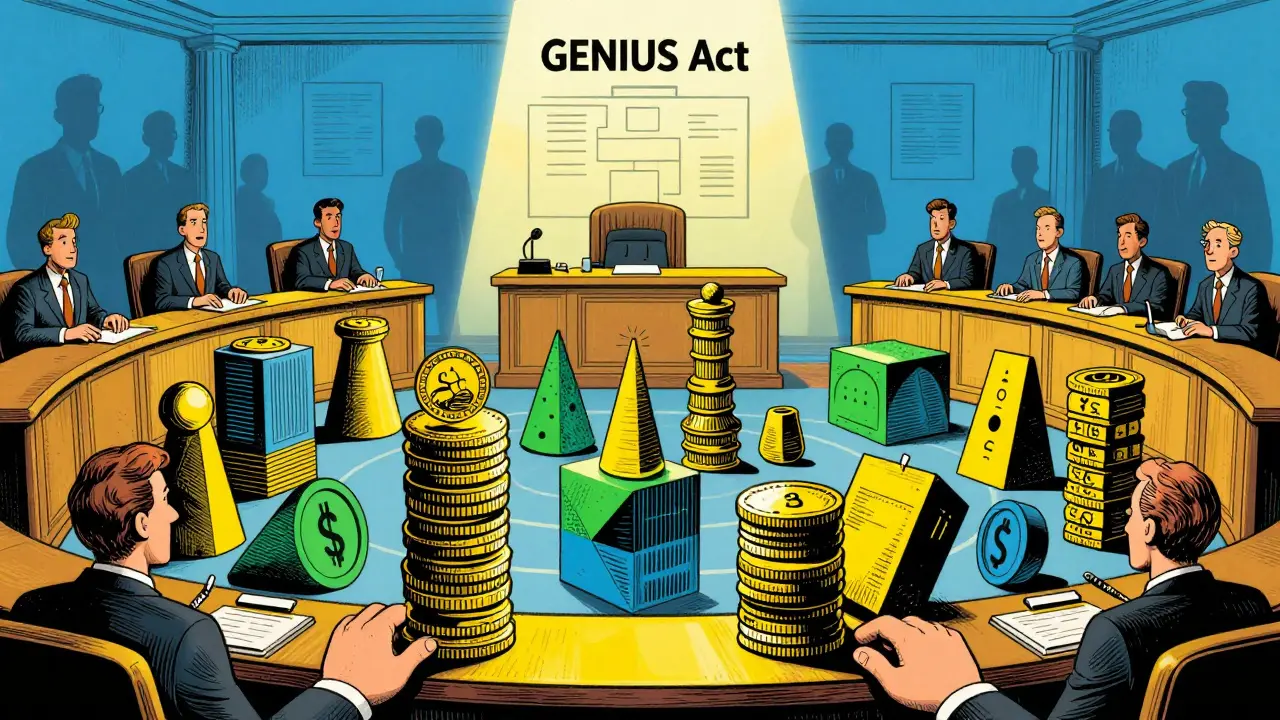
The GENIUS Act: Legislative Clarity for Stablecoins and Markets
While executive orders can be reversed by future administrations, the GENIUS Act carries the weight of statute. Signed in July 2025, this law addresses the chaotic regulatory environment that had plagued stablecoin issuers and exchanges. The act contains 27 specific provisions that clarify jurisdiction between the SEC and CFTC, define stablecoin reserves requirements, and establish tax treatment guidelines.
For businesses, this means an end to the "regulation by enforcement" era. Previously, companies often operated in gray areas, hoping agencies wouldn’t take action. Now, there is a clear path for compliance. The act specifically targets stablecoins, requiring them to maintain transparent, auditable reserves. This has already led to a surge in institutional adoption, with U.S. crypto trading volume jumping 214% between January and June 2025 according to CoinGecko data.
However, the act has drawn criticism for its narrow focus. Ethereum Foundation researcher Vlad Zamfir noted that the legislation focuses almost exclusively on Bitcoin and stablecoins, leaving many decentralized finance (DeFi) protocols without clear guidance. This creates a two-tiered system where compliant, centralized entities thrive while experimental DeFi projects face continued uncertainty.
Key Differences from the Previous Administration
To appreciate the magnitude of this reversal, compare it to the policies under the Biden administration. The previous approach was characterized by:
- Enforcement-First Strategy: Agencies like the SEC, led by Gary Gensler, aggressively pursued litigation against major crypto firms, arguing that most tokens were unregistered securities.
- CBDC Exploration: Executive Order 14067 directed the Treasury to study the feasibility of a Central Bank Digital Currency (CBDC).
- Regulatory Ambiguity: Lack of clear statutory definitions forced companies to guess at compliance requirements.
The Trump administration’s 2025 policies flip each of these points:
- Supportive Framework: The goal is to foster innovation and growth, not suppress it through litigation.
- CBDC Ban: The new administration explicitly prohibited the creation of a CBDC, citing privacy concerns and preference for private-sector innovation.
- Clear Definitions: The GENIUS Act and Working Group reports provide detailed classifications for assets, reducing ambiguity.
This shift has been welcomed by the industry. A CoinDesk survey of 500 executives found that 87% rated the changes favorably, with 72% planning to expand U.S. operations immediately. The sentiment reflects a desire for stability after years of regulatory whiplash.

Market Impact and Economic Projections
The economic implications of these policy changes are already visible. The U.S. crypto market grew from $1.2 trillion in December 2024 to $2.7 trillion by June 2025-a 125% increase. Analysts attribute much of this growth to the renewed confidence brought by the Strategic Bitcoin Reserve announcement and the GENIUS Act.
Institutional capital deployment reached $84 billion in the first half of 2025, tripling the previous six-month record. Job postings in the U.S. crypto sector increased by 189% year-over-year through May 2025. Grant Thornton projects that these policies could generate $24-38 billion in annual tax revenue by 2027 and create 450,000 new jobs by 2030.
However, risks remain. The Congressional Budget Office warned in September 2025 that if the Strategic Bitcoin Reserve grows beyond 500,000 BTC (about 2.4% of total supply), it could distort market prices. Additionally, smaller startups reported challenges keeping up with the rapid implementation timeline, with 32% needing external consultants to navigate the new rules.
What Comes Next? Implementation Roadmap
The work is far from over. The President's Working Group delivered its final report on July 30, 2025, but it included a 12-month implementation roadmap with critical deadlines:
- January 15, 2026: SEC must publish final rulemaking on stablecoin regulations.
- March 30, 2026: CFTC must issue guidance on crypto derivatives markets.
- Ongoing: Treasury continues to optimize seizure protocols to grow the Strategic Bitcoin Reserve without taxpayer cost.
As we move into late 2026, the focus shifts from policy creation to enforcement and adaptation. Companies that adapted quickly are reaping the benefits, while those waiting for perfect clarity may find themselves left behind. The message from Washington is clear: the U.S. intends to lead the digital asset revolution, and it expects the industry to keep pace.
What is the Strategic Bitcoin Reserve?
The Strategic Bitcoin Reserve is a U.S. government holding of Bitcoin acquired through criminal and civil forfeiture proceedings. Established by the March 6, 2025 Executive Order, this Bitcoin is kept as a reserve asset and cannot be sold, distinguishing it from other seized assets that are typically auctioned.
Did the Trump administration ban CBDCs?
Yes. The 2025 policy reversal explicitly prohibited the development of a U.S. Central Bank Digital Currency (CBDC). This marked a direct reversal of the previous administration’s efforts to explore CBDC feasibility, citing privacy concerns and a preference for private-sector innovation.
What does the GENIUS Act do?
The GENIUS Act, signed in July 2025, provides statutory clarity for the crypto industry. It includes 27 provisions addressing stablecoin reserves, market structure, and tax treatment, aiming to reduce regulatory ambiguity and encourage institutional investment in U.S. digital assets.
How does the Digital Asset Stockpile differ from the Bitcoin Reserve?
The Digital Asset Stockpile holds non-Bitcoin cryptocurrencies seized by the government. Unlike the Bitcoin Reserve, which cannot be sold, the Treasury Secretary has the authority to sell assets in the Digital Asset Stockpile as part of responsible stewardship strategies.
Who leads the President's Working Group on Digital Asset Markets?
The Working Group is chaired by David Sacks, appointed as the "Crypto and AI Czar." The group includes high-level officials from the SEC, CFTC, Treasury, Commerce, and Justice Departments, tasked with developing a comprehensive regulatory framework within 180 days.
Is the Strategic Bitcoin Reserve funded by taxpayers?
No. The reserve is capitalized exclusively with Bitcoin forfeited from illegal activities. The Treasury Department uses "seizure optimization protocols" to acquire these assets without using taxpayer funds for purchases.
What are the risks associated with the new crypto policies?
Risks include potential market distortion if the Bitcoin Reserve becomes too large, regulatory uncertainty for non-Bitcoin ecosystems like DeFi, and compliance challenges for smaller startups adapting to rapid changes. The CBO also warned of fiscal risks if reserve management strategies fail.
How has the market reacted to the 2025 policy changes?
The market reaction has been overwhelmingly positive. U.S. crypto trading volume increased by 214% in the first half of 2025, institutional capital deployment tripled, and job postings surged by 189%. Most industry executives rate the changes as favorable for business growth.